



Author Guidelines
1. Manuscript Submission Requirements
- Originality: Submissions must be original, unpublished works and not under consideration by another journal.
- Plagiarism: All submissions are screened for plagiarism. Any manuscripts with significant overlap with previously published works will be rejected.
- Language: Manuscripts must be written in clear, concise English.
- File Format: Manuscripts should be submitted in Microsoft Word or LaTeX format. Ensure all figures and tables are embedded in the text, with high-resolution images provided separately if necessary.
2. Manuscript Structure
Manuscripts should be structured as follows:
-
Title Page: Include the title, all author names, affiliations, and the corresponding author’s contact information.
-
Abstract: A concise abstract (150-250 words), structured without headings, must be provided, covering: (1) Background: The context and purpose of the research; (2) Methods: Key methods used; (3) Results: Main findings; (4) Conclusions: Key interpretations.
-
Keywords: 3-5 keywords relevant to the article.
-
Introduction: Contextualize the research, review key literature, and clearly state the research objectives.
-
Methods: Describe the methodology, focusing on the data collection process, models/algorithms used, performance metrics, and software tools. Ethical considerations should be included.
-
Results: Present key findings with relevant tables, figures, and statistics, focusing on trends and comparisons to baseline models or prior research.
-
Discussion: Discuss the results in the context of previous studies, address any limitations, and suggest future research directions.
-
Conclusions: Summarize the main contributions and implications of the research.
-
Acknowledgments: Mention funding sources and other contributions.
-
References: Follow the Vancouver or APA citation style.
3. Figures, Tables, and Illustrations
- Figures: Submit figures in high-resolution (300 dpi) and ensure they are properly labeled.
- Tables: Number and title each table clearly, with explanatory notes provided.
- Equations: Use standard mathematical notation, ensuring readability and clarity.
4. Ethical Considerations
- Human and Animal Subjects: Ethical approval is required for studies involving human or animal subjects. State the approval authority in the manuscript.
- Conflicts of Interest: Authors must disclose any conflicts of interest that could influence the interpretation of their findings.
5. Peer Review Process
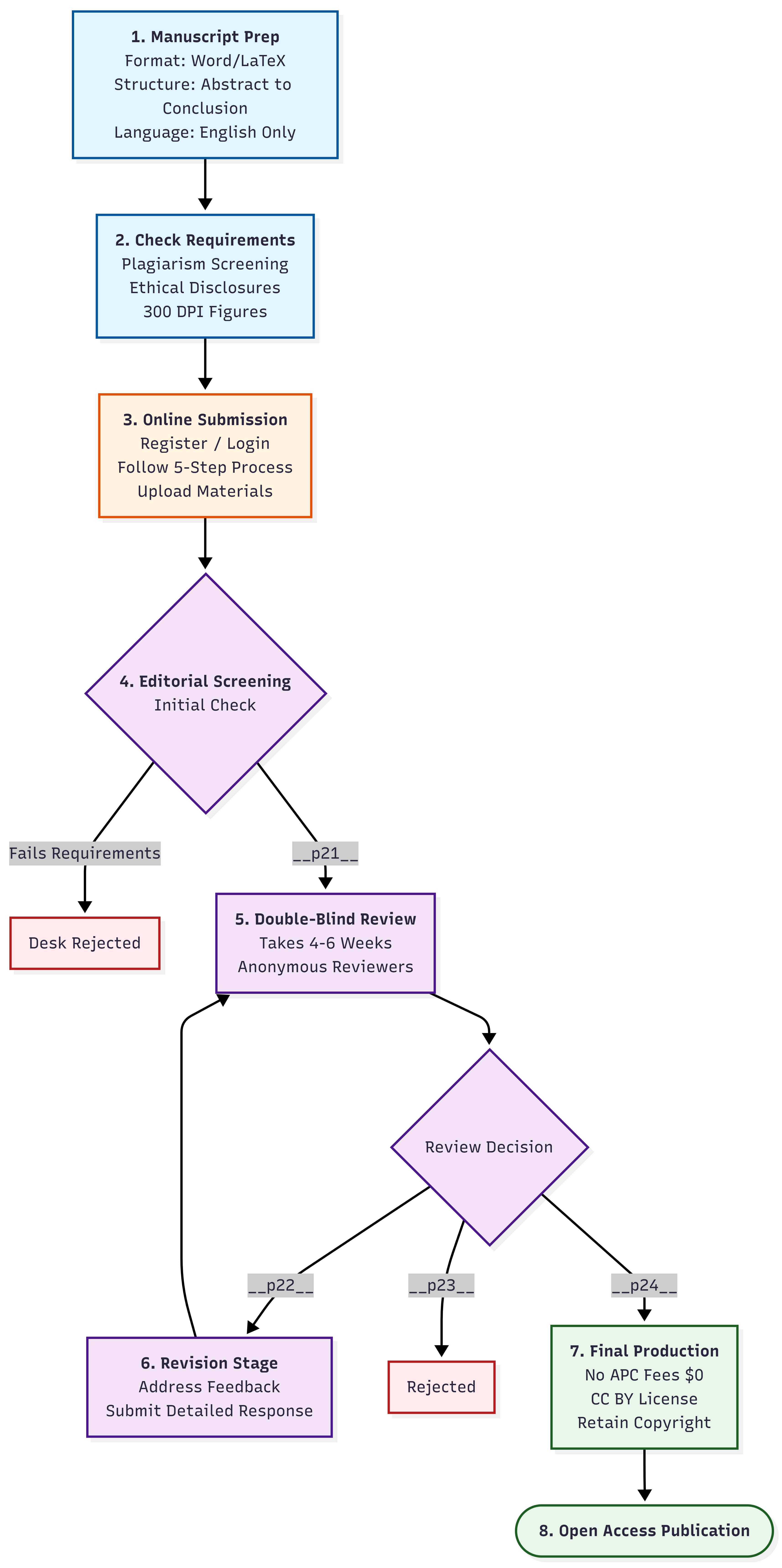
- Double-Blind Peer Review: Both authors and reviewers remain anonymous.
- Initial Assessment: Manuscripts undergo an editorial screening before peer review.
- Review Duration: The review process generally takes 4-6 weeks.
6. Revisions and Resubmissions
- Revisions: Authors may be asked to make revisions based on reviewer feedback. A detailed response to each comment is required.
- Resubmission: Substantial improvements may warrant resubmission for reconsideration.
7. Copyright and Open Access
- Open Access: All articles are freely accessible upon publication under the Creative Commons Attribution License (CC BY).
- Copyright: Authors retain copyright and grant the journal non-exclusive rights to distribute their work.
8. Article Processing Charges (APCs)
- Fees: APCs may apply upon acceptance. Details are provided on the journal website.
9. Submission Checklist
Before submitting, ensure:
- The manuscript complies with journal formatting guidelines.
- All authors have agreed to the submission.
- The manuscript includes proper citations.
- All ethical approvals and conflict of interest declarations are included.
10. How to Submit
Submit your manuscript through the journal’s online system. Register if you are a new user, or log in if already registered. Follow the five-step submission process and upload all required materials.
Journal Workflow